


Lights - Dive, Video, Photo
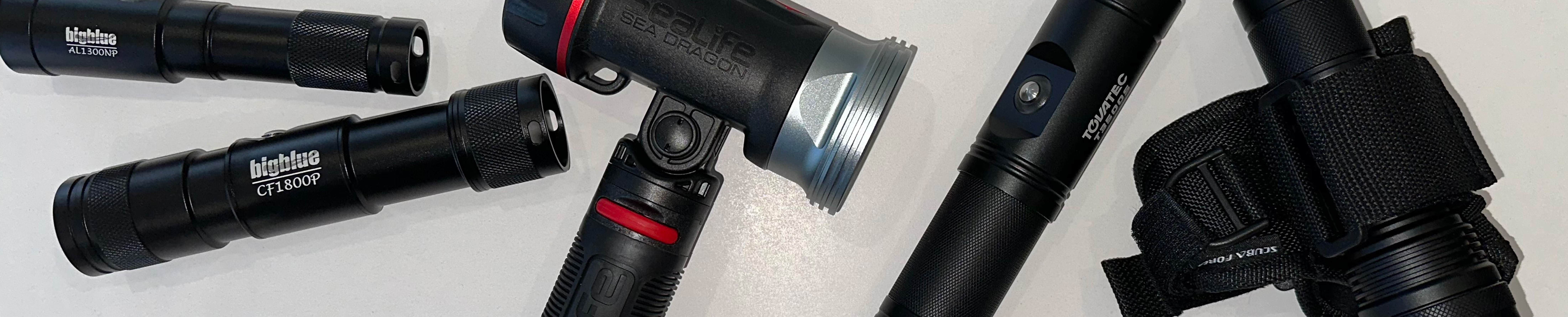 Purpose
Dive lights are used for illuminating the dark while night diving and snorkeling, for poking in cracks and crevices, and for improving color for underwater photo and video. The main thing to look for when choosing a light for scuba diving is to ensure that it is not only waterproof, but also pressure rated to avoid flooding underwater. All of our lights are pressure rated for scuba diving.
Types
A primary light is your main source of illumination for night diving, cave and wreck penetration, or exploring deeper shadowed areas on day dives. It should be bright (500+ lumens at minimum for recreational night diving), have a focused spot beam to penetrate murky water and illuminate inside crevices, and offer a long runtime. Durability and a reliable burn time are more important than raw lumen count — a light that fades out midway through a night dive is a serious problem.
Always carry a backup dive light on any night dive or penetration dive. Backup lights are smaller and less expensive than primaries but should still be pressure-rated for scuba diving depth. A compact backup that clips to a D-ring, BCD strap, or fits into a pocket means you always have redundancy without significant added bulk.
Small, lightweight marker lights clip to your tank valve, regulators, or BCD and help other divers and the boat crew locate you in the water, particularly at night or in low visibility. Strobes emit a flashing signal rather than a constant beam, making them highly visible across a wide area at the surface — excellent for marking your entry/exit point while night diving or snorkeling in open water.
Video lights need a wide, even beam to illuminate your subject uniformly without the dancing hot spot a narrow dive light produces on video. Most video lights are rated by area of coverage (beam angle in degrees) as well as lumen output. For still photography, dedicated strobes provide a brief, powerful burst of light that freezes motion and restores true colours at depth. A focus light or red-beam light helps you autofocus your camera underwater without spooking shy marine life — red light is largely invisible to most fish and invertebrates.
Features
Beam
A dive light, whether it is used during the daytime or night, should have a nice spot/narrow type beam. It needs to penetrate the water and murkiness so you can see further and into the cracks and crevices. A video light needs to have a nice bright, wide/flood beam so that the light is evenly distributed in the video. A spot beam will show up as a bright spot dancing around in your video. A focus (or red) beam light is great for focusing a camera underwater without spooking the fish and marine life.
Bulb
Virtually all modern dive lights use LED technology — they're brighter, more power-efficient, produce truer white light, and have a lifespan measured in tens of thousands of hours. Older xenon (incandescent) lights produced a warmer, more yellowish beam that some underwater photographers preferred for its naturalness, but they have largely been replaced by LEDs with adjustable colour temperature.
Battery
The type of battery and whether it is rechargeable or not is something to consider. A rechargeable light is usually more convenient and cheaper in the long-run not having to buy batteries all the time. However if you forget to pack your recharging cable or there are not power facilities on the boat or dive site, it could be a problem. Lights with throw-away batteries are usually cheaper, but always bring a spare set of batteries with you in case you need them. Some lights are a hybrid with recharging capacity as well as a battery insert for throw-away batteries.
Depth Rating
Check the depth rating on the light to ensure it meets your requirements. A light that is "waterproof" but not depth rated is not suitable for scuba diving or snorkeling. This usually means it's ok to use in the rain, but not to be submerged under pressure for any length of time.
Handle
Most lights will come with a lanyard that you can wrap and tighten around your wrist while you dive or a pistol-grip style handle. Others may have a goodman handle that allows you to hold the light on the top of your hand for a hands-free operation. Video lights mount to camera trays and arms via ball-mount or cold-shoe systems and are typically used in pairs for even illumination.